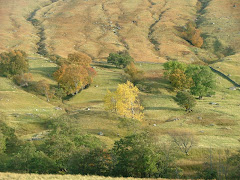
Last year the native tree seeds were collected and stored for the winter. In spring it is time to remove them from the mixture of sand and compost, sort the seeds out and re-plant them to leave outside. They need protecting from mice by covering the pots with chicken wire. They should be left in a non-drafty place out of direct sunlight, such as against a north facing wall.
Tuesday, 9 June 2009


Growing Up With Trees
These native tree seeds have been stored for the winter. Now it's time to plant them in pots. Put them in compost topped off with a little sand.
Monday, 8 June 2009
Elder flower
 Elder is the last of the Scottish native trees to flower. In Argyll the flowers are just coming out: you can see buds that have yet to burst in the background. These flowers are the basis for some of our best "Non Timber Forest Products", and it's worth trying elderflower cordial and elderflower sorbet if you get the chance. Reforesting Scotland run a website, http://www.forestharvest.org.uk/ with more information on elder and other NTFPs.
flag iris
The Flag iris is fairly common in the west of Scotland in damp woodlands. It's got a great flower, which unfortunately does no last very long. This one's fresh with morning dew.

Saturday, 6 June 2009


Goat willow bushes in Glenlyon

Many of the broadleaved woods in Breadalbane have a high % of goat willow.......although it is very palatable, it also grows very quickly, and is a very effective pioneer species in wet upland areas such as this. Even in a very heavily browsed area, a number of such bushes seem to be continually becoming established. You can see the browse line on these particular bushes.


Two trees and a buttercup

Birch in middle of picture, hazel in front. This area is heavily grazed, and there is currently little prospect of either of these seedlings maturing.......


Monday, 1 June 2009
Ash buds now bursting..........

Ash trees are normally the last to come in to leaf. Tradititionally, if they come out after oak, it is to be a hot summer, before oak, it is to be a wet summer. In practice, there is a lot of variation between individuals in different locations, but, in general, the ash seems to be the last to come out this year.......so it looks like being a hot summer.The glorious hot weather over the past few days have really encouraged them to start to come out now, although it may be a week or more yet before some individuals start to show. Here are a series of photos out and about n Highland Perthshire at the weekend.


Fresh horse chestnut leaves

Although widely planted and readily accepted as part of our current woodland culture (chiefly through children playing conkers), the horse chestnut is not actually native to the UK.....


Looking up or looking down....??

The leaves here are lime, not native to Scotland either.......(Looking down in to the Almond)


Picnic Place in the Sma Glen, Highland Perthshire

This is an excellent place to stop off for a break if you are travelling between Crieff and Aberfeldy...lovely peaceful stretch of water in the Sma Glen........


The world's largest Canadian Canoe
 The world's largest Canadian canoe is travelling around Scotland. In addition to bringing groups of Canadians across to paddle, they are also getting help from community groups as they head up the west coast. The canoe has been painted by Xa-lack-tun, who has helped a number of community woodland groups with totem pole projects over the years. #
Here's the 42 foot boat going through the Crinan Canal before heading out through the Dorus Mor. I joined them for this leg, when the canoe sprouted a mast & sail. With wind and tide in our favour we were moving along at up to 7.5 knots! More at www.spiritdancercanoejourneys.ca/
Friday, 29 May 2009
More bluebells......

This photo submitted by Jock Monteith..........bluebells on the banks of the Tay at Dunkeld.....
Thursday, 28 May 2009
Spanish bluebells
 We've had another fine year for bluebells in Scotland, and hope that you've had the chance to get out in the woods & appreciate them.
Here's a shot of a less welcome type of bluebell, the Spanish bluebell. This imported variety tends to be a bit paler in colour, and does not have the drooping flower stalk of our native bluebell. It also lacks the attractive smell that you get from our bluebells. Unfortunately the Spanish bluebell hybridises with the native species, and is spreading. If you want to plant bluebells in your garden, please make sure they are the native variety.
Monday, 25 May 2009
Clearing Rhododendron ponticum
 This picture shows the result of the first stage of clearing invasive Rhododendron ponticum from a site in Cowal. The work's being done by the owner with lots of help from local workers and volunteers. The stumps have been left long for the next stage, when a variant of the Morvern "lever and mulch" technique will use the long stems to break out the roots of the bushes. The purple flowers of ponticum are one of its few redeeming features, however it casts a shade so dense that no other flowers survive.
 This second picture shows the bluebells just beyond the edge of the ponticum. We're confident that these bluebells will spread onto the bare ground above, providing a different colour in the spring, and better biodiversity throughout the year.
Wednesday, 20 May 2009
Bluebells in Glenlyon

Bluebells at at their peak just now. Here are a number of photos from Glenlyon in Perthshire at the weekend........


Saturday, 16 May 2009

Subscribe to:
Posts (Atom)